
Most businesses are working hard. Teams are busy, deadlines are being met and systems are in place, but the output doesn’t always match the effort.
That disconnect usually comes down to three things: structure, culture, and clarity. Not as separate ideas, but as a working equation.
Structure is what allows a business to operate without constant friction. It’s the way work flows, how decisions move, and how responsibilities are defined.
When structure isn’t working, you feel it quickly. Work gets repeated, decisions stall, and people spend more time figuring things out than actually doing them. Over time, the business becomes dependent on individuals rather than systems, which makes consistency almost impossible.
Strong structure doesn’t mean adding layers or complexity. It means creating a way of working that supports performance instead of slowing it down.
Culture is often spoken about in broad, feel-good terms, but in practice it shows up in very specific ways.
It’s in how people communicate, how accountability is handled, and whether teams follow through on what’s expected. You can have well-designed processes, but if the culture doesn’t support them, they won’t hold.
A business might say collaboration matters, but if teams operate in silos, the structure breaks. Leadership might expect ownership, but if accountability isn’t reinforced, performance becomes inconsistent.
Culture either strengthens how the business is meant to operate, or it quietly works against it.
Clarity is where many businesses fall short, even when the right structures and culture are in place.
People need to understand what they’re responsible for, what good looks like, and how their role contributes to the bigger picture. Without that, effort becomes scattered.
Work gets done, but not always in the right direction. Priorities shift too often. Decisions are delayed because no one is fully certain of the outcome they’re aiming for.
Clarity creates focus, and focus is what turns activity into meaningful output.
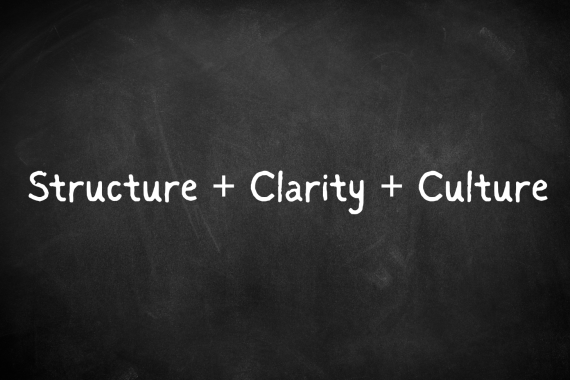
Structure, culture, and clarity don’t operate in isolation. If one is out, the others carry the strain.
A business can have strong processes, but without the right culture, they won’t be followed. It can have a positive culture, but without structure, consistency falls away. It can have clarity at a leadership level, but if it doesn’t reach the rest of the business, execution suffers.
When all three are aligned, things start to move differently. Work flows more naturally, decisions are made with confidence, and teams don’t need constant intervention to perform.
Productivity improves not because people are pushing harder, but because the business is set up to support how they work.
Trying to fix productivity by adding more usually creates more noise. More tools, more meetings, more pressure.
The shift is in stepping back and looking at how the business actually operates.
Is the structure enabling or slowing things down?
Does the culture reinforce how work should happen?
Do people have the clarity they need to execute with confidence?
If any one of these is misaligned, productivity will always feel harder than it should.
NDK Group works with businesses to align structure, culture, and clarity so performance becomes consistent, measurable, and sustainable.